
Porter’s Five Forces: A Beginner’s Guide to an Industry’s Battlefield Report

Written by Nicholas • Reviewed by Reginald, our mentor guide
⏱️ Read Time: 2-3 minutes (+ optional 50-second video)
📅 Published March 26, 2026 • Updated June 13, 2026
TL;DR
Porter’s Five Forces helps you judge how tough an industry is.
It looks at rivalry, new entrants, suppliers, buyers and substitutes.
Stronger forces mean more pressure on profits.
A great company can still struggle if the industry is highly competitive.
Source: Porter’s Five Forces was introduced by Harvard Business School professor Michael E. Porter in his 1979 Harvard Business Review article, How Competitive Forces Shape Strategy. On Young Investor Journey, we use the framework as a beginner-friendly way to understand how competitive an industry is.
What really controls a company’s profits? It’s not just about what they sell.
In this quick breakdown, Reginald introduces Porter’s Five Forces — a powerful framework to analyze how tough an industry really is before spending hours digging into a company.
A business can look impressive on the surface but if it operates in a brutal industry, protecting profits becomes much harder.
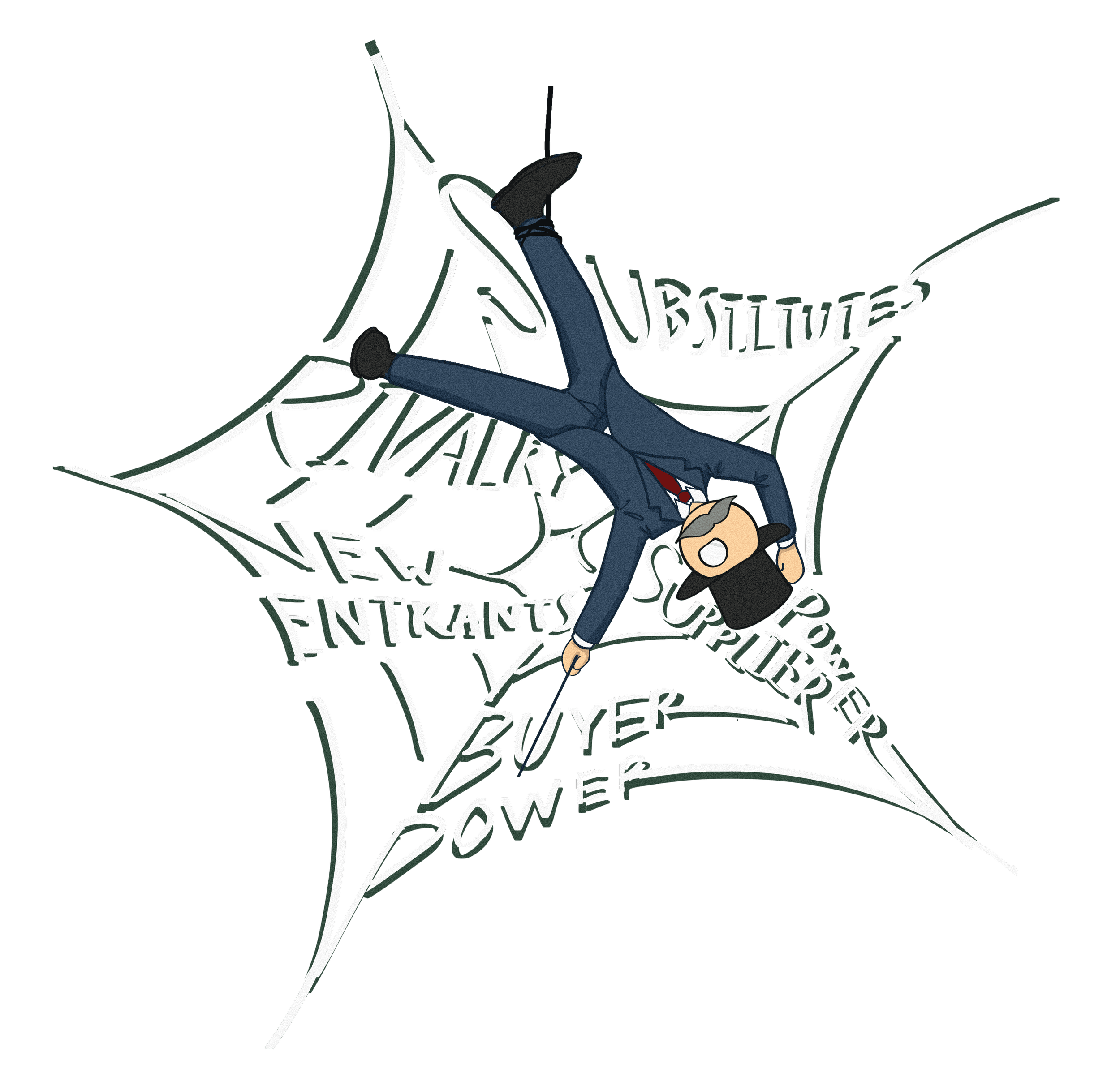
Porter’s Five Forces Cheat Sheet
Think of Porter’s Five Forces as an industry battlefield report.
Instead of asking whether this is a good company, the framework asks:
Rivalry: How intense is the competition between existing players?
If many companies are selling similar products, they often compete aggressively on price, promotions, convenience and marketing. That can make it harder for any one company to stand out.
More rivalry usually means more pressure on margins.
New Entrants: How easy is it for new challengers to enter the industry?
Some industries are easy to enter. Others are protected by strong brands, scale, regulation, high upfront costs or access to prime locations.
High barriers to entry make it harder for new challengers to attack profits.
Suppliers: Who has more power — the business or its suppliers?
If a company depends on a small number of suppliers or on inputs that are hard to replace, suppliers can push prices higher and squeeze profitability.
Stronger suppliers can take a bigger slice of the pie.
Buyers: Who has more power — the business or its customers?
If buyers can switch easily, compare prices quickly or choose from many similar options, the company has less control.
Stronger buyers usually mean weaker pricing power.
Substitutes: Can the product be easily replaced by something else?
A substitute does not need to look exactly the same. It just needs to offer another way for the customer to meet the same need.
Example: A fast-food burger does not only compete with other burgers. It also competes with hawker food, convenience-store meals, meal delivery and home cooking.
More substitutes mean more ways demand can leak away.
The Bottom Line
These five forces are in a constant battle. The stronger these forces are, the harder it usually is for a company to defend its profits over time. That is why industry structure matters so much for investors. Porter’s Five Forces works especially well as an early filter before diving deeper into a business.
Once you understand the industry battlefield, you can use a SWOT analysis to study the company itself, and moat thinking to ask whether its advantages can last.
Next up: We apply Porter’s Five Forces on McDonald’s in a separate case study: McDonald's Porter’s Five Forces Analysis: The Battlefield Report.
Let’s keep growing together 🌱
— Nicholas
Prefer to watch? Here's the 50-second version:
Having trouble viewing the embedded video? Watch it on Instagram: Porter’s Five Forces
Frequently Asked Questions
-
Porter’s Five Forces is a framework for judging how competitive an industry is. It looks at five pressures: how intense the rivalry is between existing companies, how easy it is for new competitors to enter, how much power suppliers have, how much power buyers have and how easily customers can switch to substitutes. The stronger these forces, the harder it is for any company to consistently earn good profits.
-
They answer different questions. SWOT analysis looks at a specific company — its internal strengths and weaknesses, and the external opportunities and threats it faces. Porter's Five Forces looks at the industry as a whole — how competitive it is and how much pressure exists on everyone operating within it. Used together, they give you a fuller picture: SWOT tells you about the company, Five Forces tells you about the battlefield it's fighting in.
-
Early in your research, before diving into financials. Porter's Five Forces works best as a filter — it helps you quickly judge whether an industry is attractive or brutally competitive before spending hours on earnings reports and valuations. If the industry structure looks very tough, that context shapes how you interpret everything else.
-
Yes — and this is one of the most important lessons in investing. A company can have great management, strong branding and loyal customers and still face constant pressure on profits if rivalry is intense, buyers can switch easily, or substitutes are everywhere. The fast-food industry is a good example: McDonald's is an exceptional business, but it still operates in a fiercely tough environment. Industry structure is the water the company swims in.
-
Yes. Industry structure can shape a company’s profits for many years. For long-term investors, Porter’s Five Forces is useful because it helps you ask whether a company’s advantages are protected, or whether they are constantly under attack.
Spotted an error?
Email us at contact@younginvestorjourney.com. We review factual corrections and update articles where needed.
Continue the Journey
Read this next: McDonald's Five Forces Analysis: The Battlefield Report
McDonald's Five Forces Analysis: The Battlefield Report

SWOT Analysis: A Beginner’s Guide

Stocks vs. ETFs for Beginners
About Young Investor Journey
I’m Nicholas — a young investor learning out loud. With guidance from my mentor, Reginald, and illustrations by Timothy, we break down complex investing ideas into plain English — no fluff, no jargon, just clarity.
How We Think
We help you build a framework you can apply to any company. Our framework is simple: understand the business model first, confirm with official reports, then sanity-check with trusted sources. The goal is to teach you how to think — not what to buy.
Education Only: We are here to share what we learn, not to give financial advice. Always do your own research and consider your personal goals, risk tolerance and financial situation before investing.