
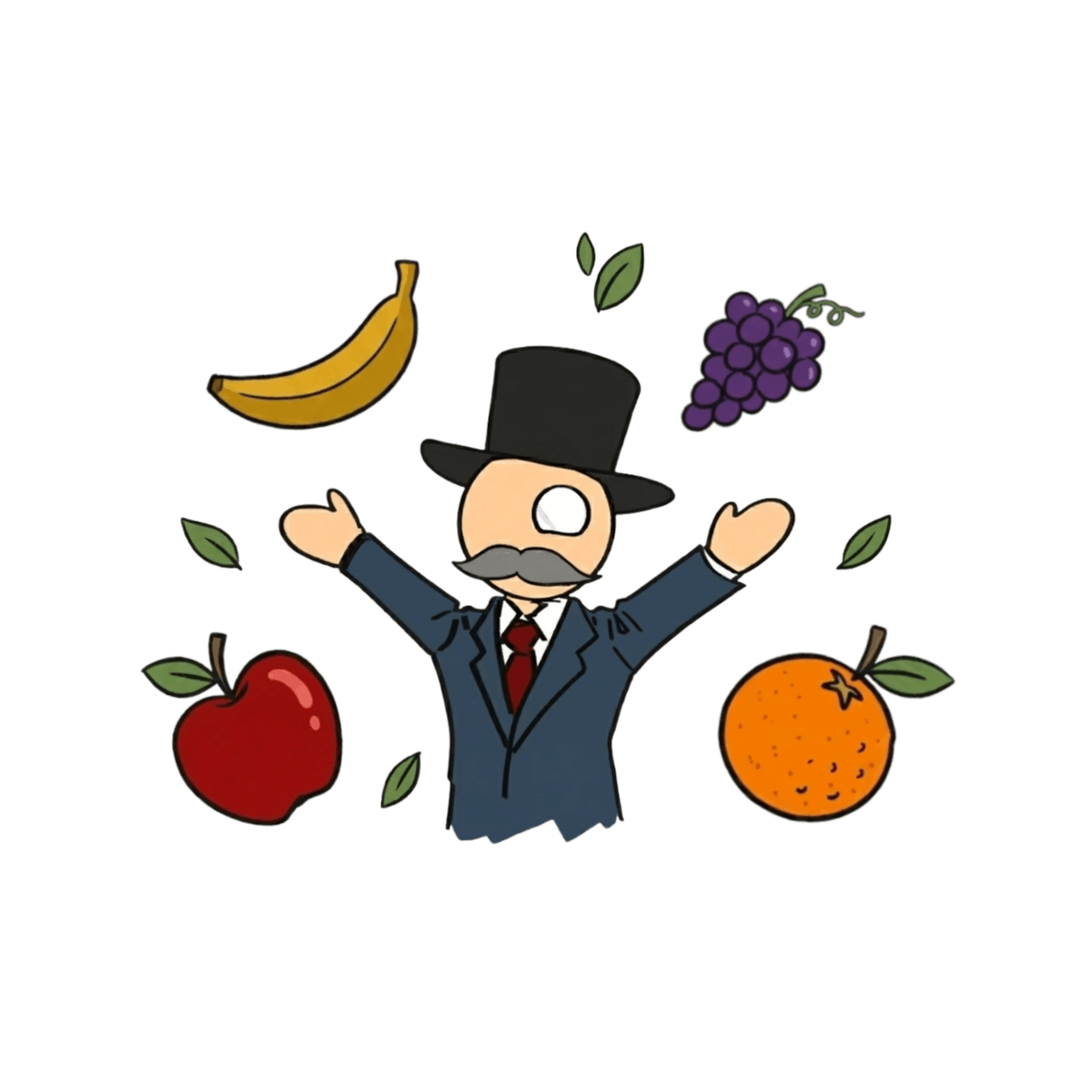
Written by Nicholas • Reviewed by Reginald, our mentor guide
⏱️ Read Time: 2-3 minutes (+ optional 60-second video)
📅 Published January 15, 2026 • Updated June 13, 2026
TL;DR
Single Stock = One Apple: Big upside if you pick right — but one bad apple can hurt you.
ETF = Fruit Basket: Instant diversification so one bad fruit doesn’t spoil everything — but you still need to choose the basket wisely.
Reginald’s Warning: Not all baskets are diversified (sector/theme ETFs can be risky).
Beginner-Friendly Path: Start with baskets while you learn how to pick apples.
For most beginners, ETFs are usually the simpler starting point because they spread your money across many companies instead of relying on a single one. Picking individual stocks can feel like trying to find the one perfect apple in a giant orchard — if you pick right, the reward can be huge … but if you pick a bad one, the damage can hurt a lot more.
In this quick breakdown, we use Reginald’s framing to explain why many beginners start with the fruit basket before learning how to pick their own apples.
Stocks vs. ETFs: The Key Difference
Single Stock = One Apple 🍎
The Concept: You’re picking one company.
The Upside: If you choose the right company, the reward can be huge.
The Risk: If that one company struggles badly (the bad apple), your portfolio can take a much bigger hit.
A perfect apple can outperform the basket — but you have to find it.
ETF = The Fruit Basket 🧺
The Concept: ETF stands for Exchange Traded Fund. It is a basket of many investments that trade like a stock.
The Upside: You get instant variety. One bad apple is less likely to spoil your whole portfolio because the basket does not rely on a single fruit.
The Risk: You still have to choose the basket wisely.
A basket protects you from betting everything on one apple.
Some are narrow, niche or heavily concentrated. A basket of only apples — or only oranges — is not real diversification.
Always check what is inside the basket before you buy.Not every basket is pure fruit as well — many ETFs also hold bonds, which behave very differently from stocks. I've compared the two in Stocks vs. Bonds: Growth or Stability?
Broad ETF:
A broad ETF usually tracks a wide market, such as many companies across different sectors. It is often more diversified and may be easier for beginners to understand.
Thematic ETF:
A thematic ETF focuses on a specific idea, sector or trend, such as technology, clean energy or artificial intelligence. It may feel exciting, but it can also be more concentrated and more volatile if the theme disappoints.
The key is to check what the ETF actually owns before assuming it is diversified.
Watch out for ETF overlap:
ETF overlap happens when two ETFs own many of the same companies. You may think you are more diversified because you own two ETFs, but if both hold many of the same stocks, your portfolio may be more concentrated than it looks.
For example, two broad market ETFs may both hold large technology companies. That does not make them bad, but it means you should look under the hood before assuming they are completely different.
Quick checklist before you buy an ETF:
What does it hold? (broad market vs. sector vs. theme)
How concentrated is it? (top 10 holdings %)
Fees (expense ratio)
What market does it track? (US, global, tech etc.)
For most beginners, the basket is the simpler starting point but the right choice depends on where you are in your journey — here is a quick way to think about it.
A Simple Way to Choose
Many investors start with ETFs, then gradually build the confidence to choose individual stocks for themselves.
Choose stocks if:
you enjoy researching companies (like we do!)
you are comfortable being wrong
you want more control over what you own
Choose ETFs if:
you want a simpler starting point
you want diversification from day one
you are still building confidence as an investor
The Third Path: Build Your Own
There is also a third path: building your own basket by choosing individual stocks yourself.
This takes more time, research and discipline — but it gives you full control over what you own. Instead of buying a ready-made basket, you build one fruit by fruit.
This is essentially what we are doing across this site — studying McDonald's, understanding its business model, checking its moat, defenses and financials. That process is what it looks like to research an individual company before adding it to your own basket. The case studies in this series are here to give you that practice.
If you eventually want to build your own basket, start by learning how to analyse one business properly — its business model & SWOT, Five Forces and moat.
For many beginners, ETFs are a simple place to start — but over time, some investors want the confidence to build their own basket.
Final Words
Which strategy fits your journey?
You do not have to pick a side forever. Some investors prefer the potential of a single apple. Some prefer the simplicity of a ready-made basket. And some eventually want to build their own basket from scratch — fruit by fruit, with full control over what goes in.
If you are a beginner, you do not need to find the perfect apple on day one. You probably need a basket that helps you start steadily, stay invested and keep learning.
Over time, that basket can also become your classroom. As your confidence grows, you may eventually want to start picking your own fruit alongside it — building your own basket one company at a time.
That’s the real goal: not just to own investments — but to understand what you own well enough to shape your own journey with confidence.
Let’s keep growing together 🌱
— Nicholas
Prefer to watch? Here's the 60-second version:
Having trouble viewing the embedded video? Watch it on Instagram: Stocks vs. ETFs
Frequently Asked Questions
-
ETF stands for Exchange Traded Fund. Think of it as a ready-made basket of many investments — stocks, bonds or other assets — that you can buy and sell on a stock exchange just like a single stock. Instead of picking one company, you're buying a slice of many at once. Most ETFs track an index, meaning they aim to match the performance of a group of companies like the S&P 500.
-
Diversification means spreading your money across different investments so that one bad outcome doesn't sink your whole portfolio. The fruit basket analogy in this post captures it well — if one apple goes bad, the rest of the basket is still fine. Diversification doesn't eliminate risk, but it reduces the damage any single investment can do.
-
Not always. ETFs reduce single-company risk by spreading your money across many investments at once, so one bad apple hurts less, but you can still lose money — especially with narrow sector or theme ETFs that concentrate heavily in one area. A tech-only ETF, for example, still falls sharply when the tech sector drops. Always check what's inside the basket before assuming it's safe.
-
Yes — and many investors do. A common approach is to start with a broad-market ETF as your foundation, then gradually add individual stocks as you build confidence and learn how to research companies. This lets you stay invested and diversified while you develop the skills to pick your own apples.
-
Start by checking what it holds — is it a broad market ETF, a sector-specific one, or a theme-based one? Then look at how concentrated it is by checking the top 10 holdings as a percentage of the fund. Finally check the expense ratio (the annual fee) and which market or index it tracks. Most ETF providers publish all of this on their website.
-
An expense ratio is the annual fee an ETF charges to manage the fund — expressed as a percentage of your investment. A 0.03% expense ratio on a broad-market ETF is barely noticeable, but fees of 0.50% or higher on a themed ETF quietly eats into your returns every single year — and some specialty funds charge significantly more. Over decades, that difference compounds significantly. Lower fees are generally helpful, all else being equal.
-
One or two is plenty to start. A single broad-market ETF — one that tracks something like the S&P 500 or a global index — already gives you exposure to hundreds of companies at once. Adding more ETFs too quickly can create accidental overlap, owning the same companies multiple times without meaningfully improving diversification. Start simple, understand what you own and add complexity only when it serves a clear purpose.
Spotted an error?
Email us at contact@younginvestorjourney.com. We review factual corrections and update articles where needed.
Continue the Journey
Read this next: The Two Principles That Matter More Than Picking the Right Stock

The Two Principles That Matter More Than Picking the Right Stock

McDonald’s SWOT Analysis: Beyond the Burger

Where Do I Begin? How to Start Investing as a Beginner
About Young Investor Journey
I’m Nicholas — a young investor learning out loud. With guidance from my mentor, Reginald, and illustrations by Timothy, we break down complex investing ideas into plain English — no fluff, no jargon, just clarity.
How We Think
We help you build a framework you can apply to any company. Our framework is simple: understand the business model first, confirm with official reports, then sanity-check with trusted sources. The goal is to teach you how to think — not what to buy.
Education Only: We are here to share what we learn, not to give financial advice. Always do your own research and consider your personal goals, risk tolerance and financial situation before investing.